Hardware Projects
Voice Transciever:
Spring 2026
Coming Soon!
Wavelength Division Multiplexer (WDM):
Summer 2024
Wavelength division multiplexing (WDM) is a foundational technique in fiber-optic communication that enables multiple data streams to be transmitted simultaneously over a single optical channel by assigning each stream a distinct wavelength. Each wavelength id independently modulated, optically combined using wavelength-selective elements, transmitted through a shared medium, and then seperated and detected at the reciever
Inspired by this principle, I built a three-port optical WDM system using laser points, trichroic crystals, photodetectors, and Arudino-based control. The trichroic crystals were used to multiplex and demultiplex three laser wavelengths, with each channel implementing independent data transmission. I developed a custom communication protocl for the green laser and using Arduino Serial communication for the remaining channels, achieving a 92% end-to-end transmission accuracy. Mechanical alignment was done through custom-desigend mounts modeled in Fusino 360 and 3D printed. We also evaluated system robustness by introducing optical disturbances and implementing basica data recovery logic.
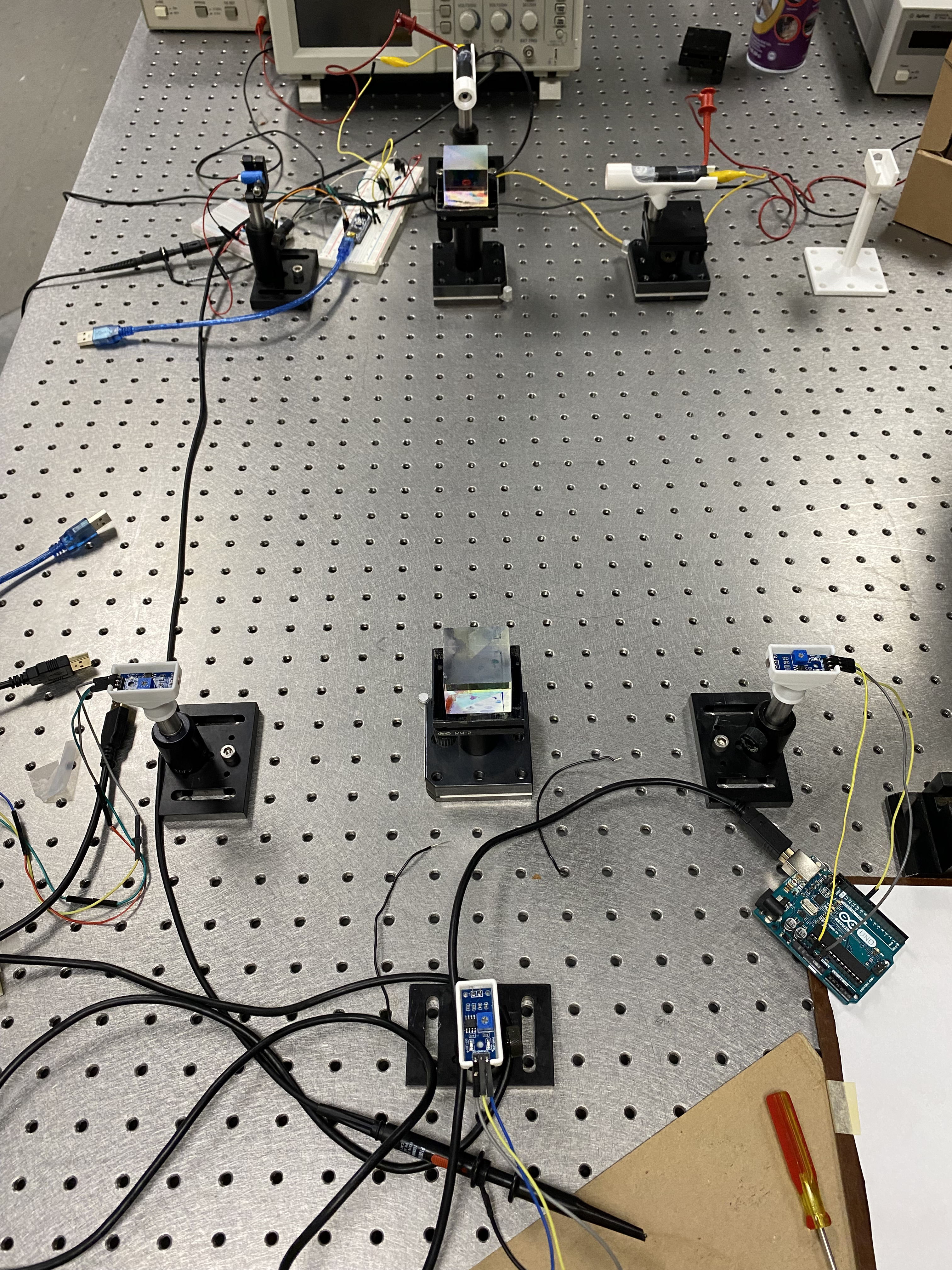
Physical setup of the WDM
Software Projects
Formula One Prediction Model:
Winter 2025/2026
This project started from my interest of F1 (Essere Ferrari) as well as wanting to learn more about ML.
The goal of this model is to predict the finishing order of drivers using historical race data.
I trained a gradient-boosted decision tree model (LightGBM), selected for tis strong performance on tabular data, ability to model nonlinear feature interactoins, and built-in regularization.
Input features inclued lap times, grid position, track conditions, and environmental variables.
Because race outcome prediction is a ranking problem, the NDCG@1/3/10 metric was chosen as it emphasized correctness within meaninful outcome groups (winner, podium, points), rather than individual classification accuracy
Furthermore, the features were engineered with shifted windows in pandas to prevent data leakage, so that only information avilable prior to each race was used for prediction.
The final model utilized 16 temporal features and achieved NDCG@1/3/10 scores of 0.98, 0.97, and 0.94 respectively.
Currently, I am trying to predict average race times using a seperate LSTM model architecture, that could also serve as another temporal feature to model my results.
Additionally, I am performing robustness checks and validation experiments to investigate potential sources of my overly optimistic performance to ensure that the model generalizes beyond the training data.
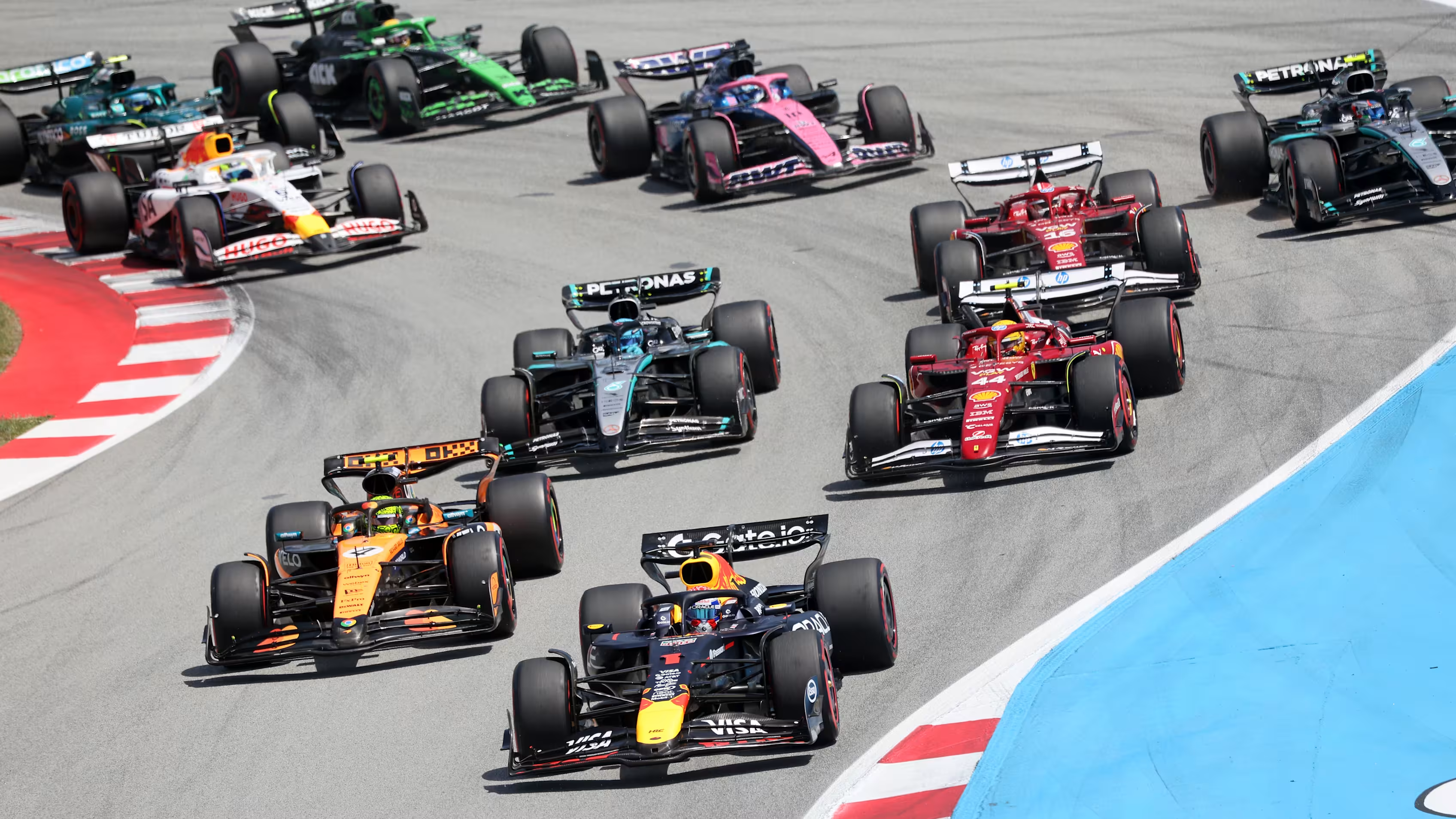
Vroom Vroom
Scheme Interpreter:
Fall 2025
I developed a fully functional interpreter for the Scheme programming language in Python, implementing core language features including expression parsing, evaluation, and environment management. The interpreter supports both lexical and dynamic scoping through chained environments, enabling correct handling of closures and variable resolution. Additionally functionality includes user-defined procedures, arithmetic and logical primitives, and higher-order functions, adhering closely to Scheme's evaluation semantics.
Enjoy a piece of art I made with the interpreter via an external Turtle graphics interface, earning fifth in a class-wide programming competition.
Video of Scheme Art
Art Source Code: Link
Personal Website:
Winter 2025/2026
This website! It Utilizes HTML, CSS, and Javascript as the tech stack to create a responsive UI/UX that showcases my portfolio through links, images, and descriptions. I am currently in the process of transfering this into a more modern framework with React and Typscript.
Source Code: Link
Other
International Baccalaureate Papers:
I was a International Baccalaureate Diploma Recipient in high school, and below are some of my papers I have written for the certificate:
Source Code: Link