Research
Biomimetic Millisystems Lab (BML):
Undergraduate Researcher (October 2025-present)
I conduct research under Prof. Ronald Fearing and Dr. John Atkins at the Biomimetic Millisystems Lab, developing control systems for a 7-DOF MRI-compatible robotic arm. My work spans embedded firmware, real-time control, hardware bring-up, and high-fidelity simulation.
I implemented PD and impedance controllers with disturbance observers in CoppeliaSim, leveraging joint-space dynamics and Jacobian-based mappings. Additionally, I have integrated ROS2, MoveIt, and CoppeliaSim for motion planning, consuming trajectories via a Python-ZeroMQ bridge for simulation validation. Furthermore, I develop low-level embedded firmware for ultrasonic motor control and perform PCB bring-up for arm encoder and pressure sensor boards. To accelerate simulation workflows, I've optimized numerical computations using JAX/XLA with automatic differentiation and vectorization, achieving 2x throughput improvements.
My development stack includes Ubuntu, Linux, ROS2, and profiling tools to identify bottlenecks in control loops and physics simulation pipelines.
Berkeley Haas School of Buisness:
Undergraduate Researcher (February 2026-present)
I conduct research under Prof. Anastassia Fedyk relating to cleaning and classiyfing big data for machine learning models. More on the way!

Professional Experiences
Formula Electric at Berkeley (FEB):
Accumulator Electrical Engineer (October 2025-present)
I am currently designing and validating a 4-layer segment-level battery management system (BMS) PCB for a custom 140s3p accumulator, where each segment board monitors fourteen cells. The segment board serves as the primary control and monitoring unit at the module leve, integrating ADBMS ICs for cell voltage measurements via board-to-board connections and multiplexed temperature sensing through ribbon cables. The system communicates with adjacent boards using isoSPI and CAN, providing robust data transfer and isolation in a high-voltage environment.
To validate the design, I simulate fourteen-cell battery segment using a resistor-divider network stepping down from 52V and verify voltage measurement accuracy and fault behavior. Cell balacning functionality is tested by deploying STM32 firmware on a companion controller board, which transmits balancing commnads over isoSPI to the ADBMS IC, enabling end-to-end verification of monitoring and control paths.
Engineering Solutions at Berkeley (ESB):
Senior Engineering Consultant (January 2026 - Present): TBD
More to Come!
Engineering Consultant (September - December 2025): Magnitude.io
I worked with a multidisciplinary team to develop a random positionig machine designed to simulate microgravity conditions for fungal growth experiments on Earth. I designed a two-layer control PCB and mechanical housing integrating an ESP32, terminal blocks for power and signal interfaces (including an optical encoder and motor driver), and a USB-C interface. The board accepts a 12V input and generates regulated 5V and 3.3V rails for system operation.
The controller communicates with a Raspberry PI over I2C and interfaces with an Adafruit capacitive touch display using SPI and GPIO. In addition, I contributed to the development of randomized motion trajectories using Fourier-series-based methods and pseudo-random binary sequences, leveraging encoder feedback to generate continuously varying orientation paths.
Innovative Building Energy Control:
Test and Validation Engineer (December 2025 - January 2026):
As an independent contractor, I executed hardware bring-up and debugged over fifty 2-layer PCBs built around ATmega328p microcontrollers. These boards integrated isolated AC-DC conversion, onboard rectification, and regualted 5V and 3.3V power rails. Using oscilloscopes and multimeters, I verified power integrity, regulation stability, and MCU operation. In parallel, I implemented a solar panel telemetry system that collected current data, displayed it onto LCD interfaces, and transmitted over Wi-Fi for remote monitoring.
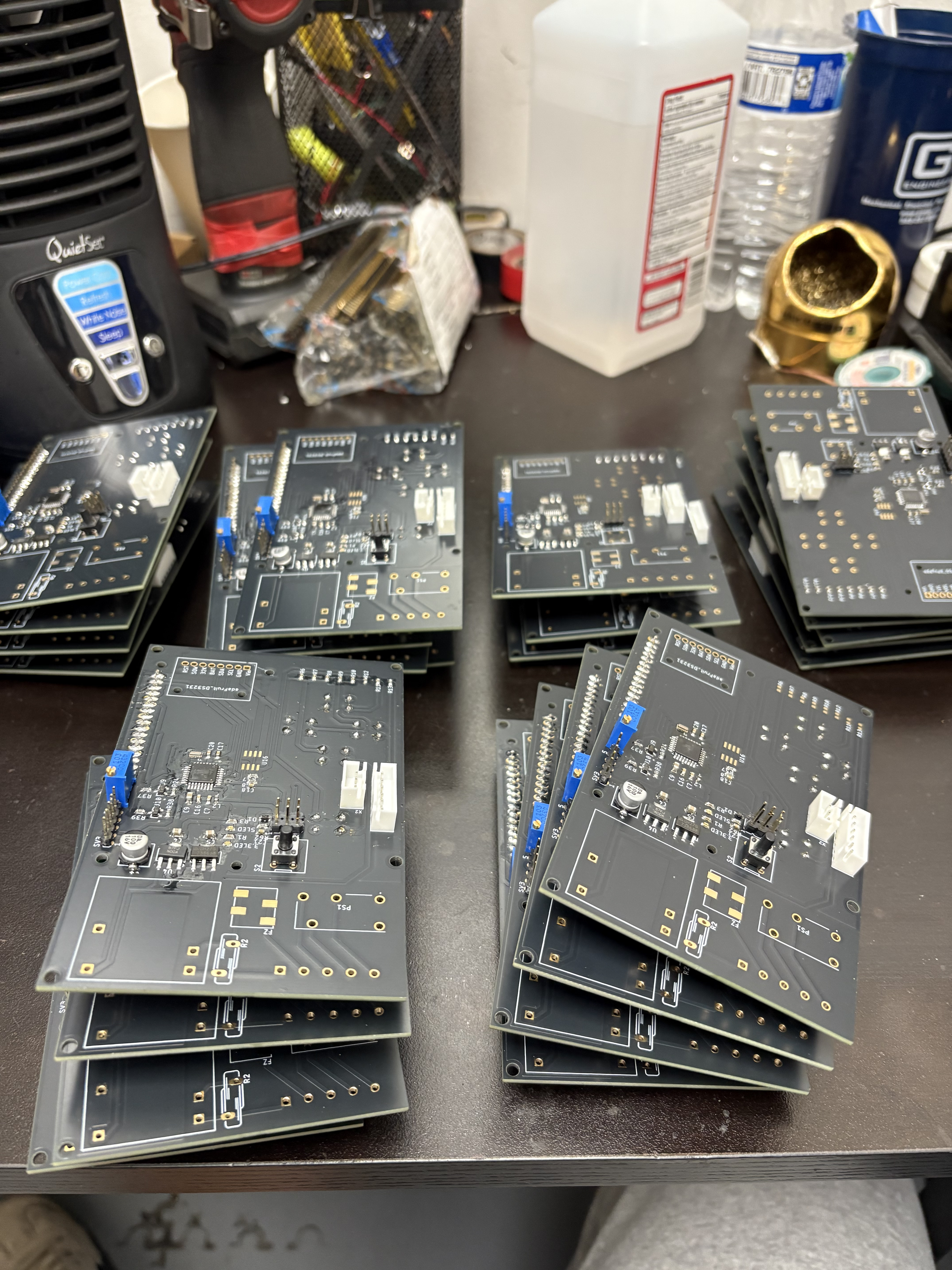
Some of the boards that I brought up and validated
Other
High School Quests:
I also competed in academic competitions:
- USA Computing Olympiad Gold Qualifer
- American Invitational Mathematics Exam Qualifier
- American Computer Science League Bronze Medalist